

Republicans outspent Democrats by $188M in Senate battleground advertising through 9/30, breaking a trend from the past three cycles. Cook Political Report currently rates nine 2026 Senate races as Toss Up, Lean Democrat, or Lean Republican: Alaska, Iowa, Kansas, Maine, Michigan, New Hampshire, North Carolina, Ohio, and Texas. Republicans accounted for 60% ad spending in those battleground general elections and held the advantage in eight of the nine.
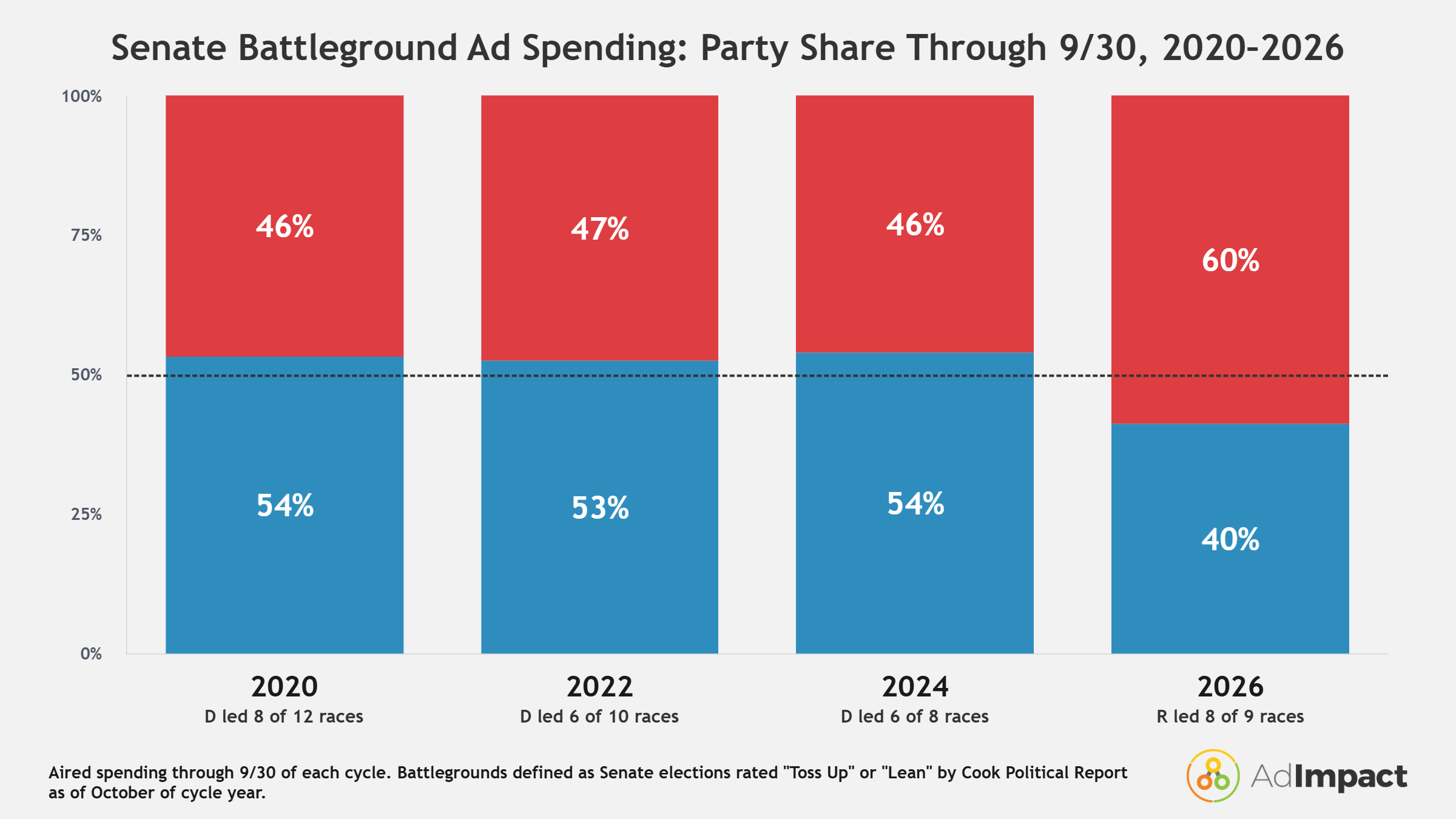
In each of the past three cycles, Democrats accounted for 53-54% of such spending through 9/30. They also held the advantage in most of those races: eight of twelve in 2020, six of ten in 2022, and six of eight in 2024. This year’s 20% gap is not only the first Republican advantage of the past four cycles but is also the biggest. Additionally, 2026 marks the first time in that span that Republicans have led in more than four Senate battlegrounds through the end of September.
2026 Senate Ad Activity Through 9/30
Through the end of September, Senate battleground general elections saw more than $935M in aired advertising. Ohio and Texas saw the most activity, receiving 47% of that total. Republicans led by at least $12M in six races: Texas (+$61M), Ohio (+$41M), Maine (+$27M), Iowa (+$17M), Michigan (+$15M), and Alaska (+$12M). They led overall in eight of the nine, including all six Toss Up races.
Republican issue groups drove that advantage. They aired $487M, or 87% of all Republican Senate battleground spending. SLF PAC, Texas PAC, and One Nation made up 59% of that total, while Trump-affiliated MAGA Inc. and No Going Back PAC added another 13%. Republican Texas nominee Ken Paxton received the most group support, as more than 98% of Republican Texas activity came from issue groups.
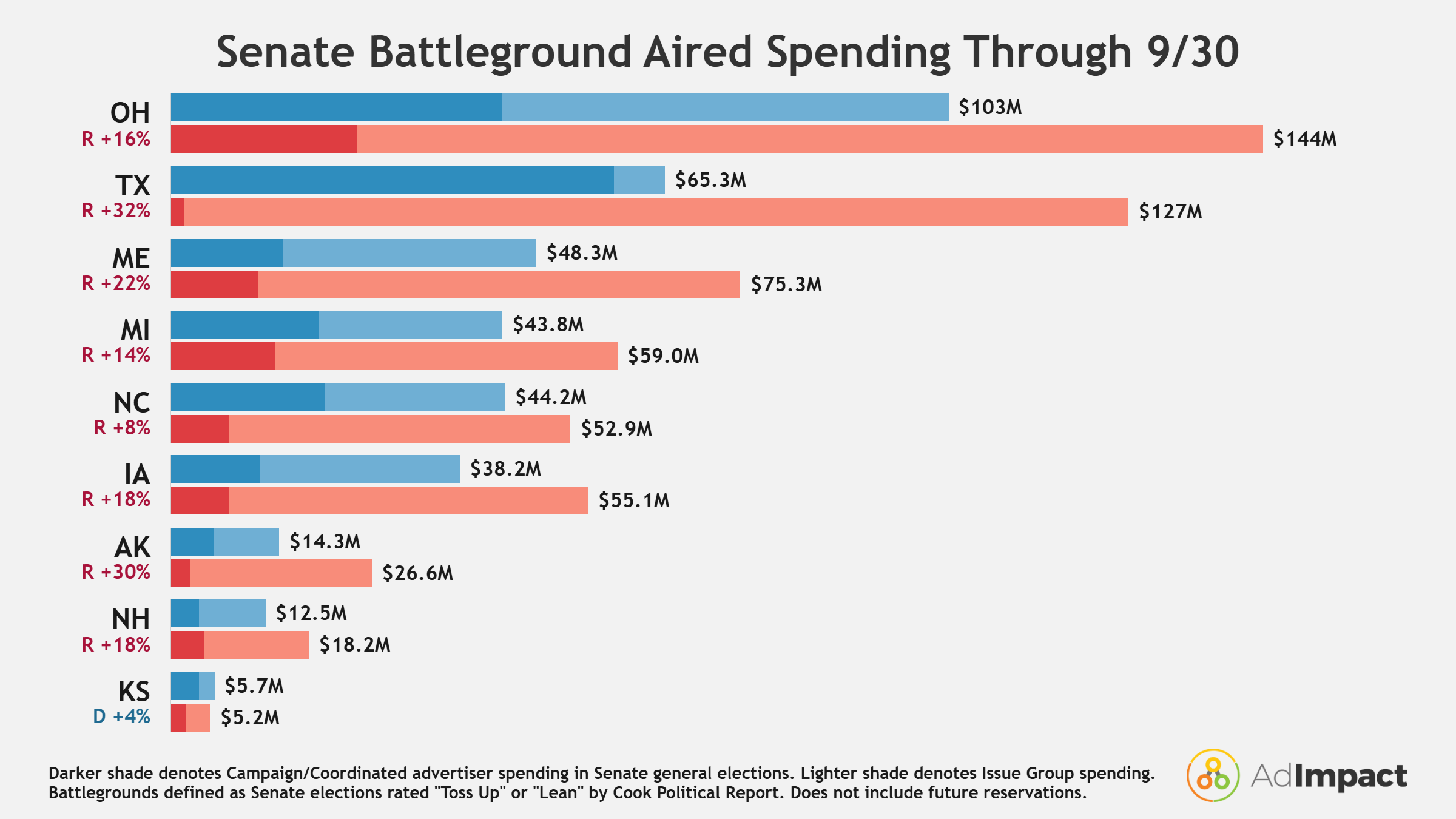
Democratic candidates and coordinated buys, meanwhile, outspent their Republican counterparts by more than two to one. Six Democratic candidates spent more than $10M: James Talarico (TX, $59M), Sherrod Brown (OH, $41M), Roy Cooper (NC, $19M), Abdul El-Sayed (MI, $18M), Troy Jackson (ME, $13M), and Josh Turek (IA, $11M). On the Republican side, only the NRSC’s coordinated buys with Jon Husted (OH, $13M) and Mike Rogers (MI, $12M) topped $10M. Candidates are entitled to the lowest unit rate in the final 60 days of a general election, so their dollars buy more airtime. That helped Democrats offset the overall Republican advantage. Republicans led broadcast spending in seven of the nine battlegrounds and by 26% overall but, led broadcast airings by just 7%.
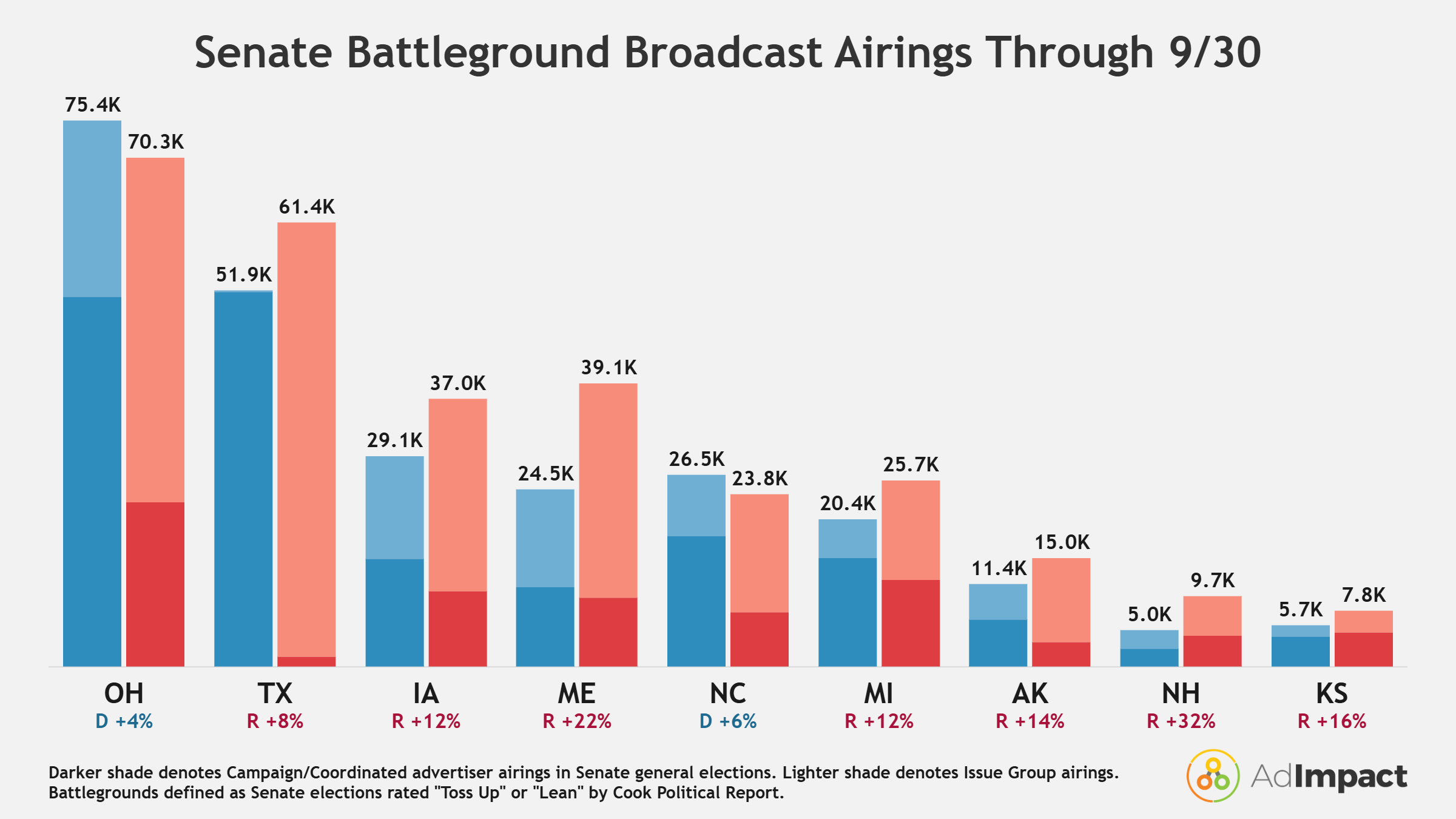
In Texas, a 44% Republican broadcast spending advantage yielded only an 8% airings advantage. Democrats led broadcast airings in Ohio and North Carolina despite being outspent on broadcast in both states.
Looking Ahead
Senate battlegrounds currently have $513M in future reservations for the final 34 days of the election. Republicans account for 61%, slightly above their 60% share of aired spending. Issue groups have placed 83% of all reservations: $272M for Republicans and $155M for Democrats. Ohio has seen the most future reservations (R +$32M), and Texas has the largest gap (R +80%).
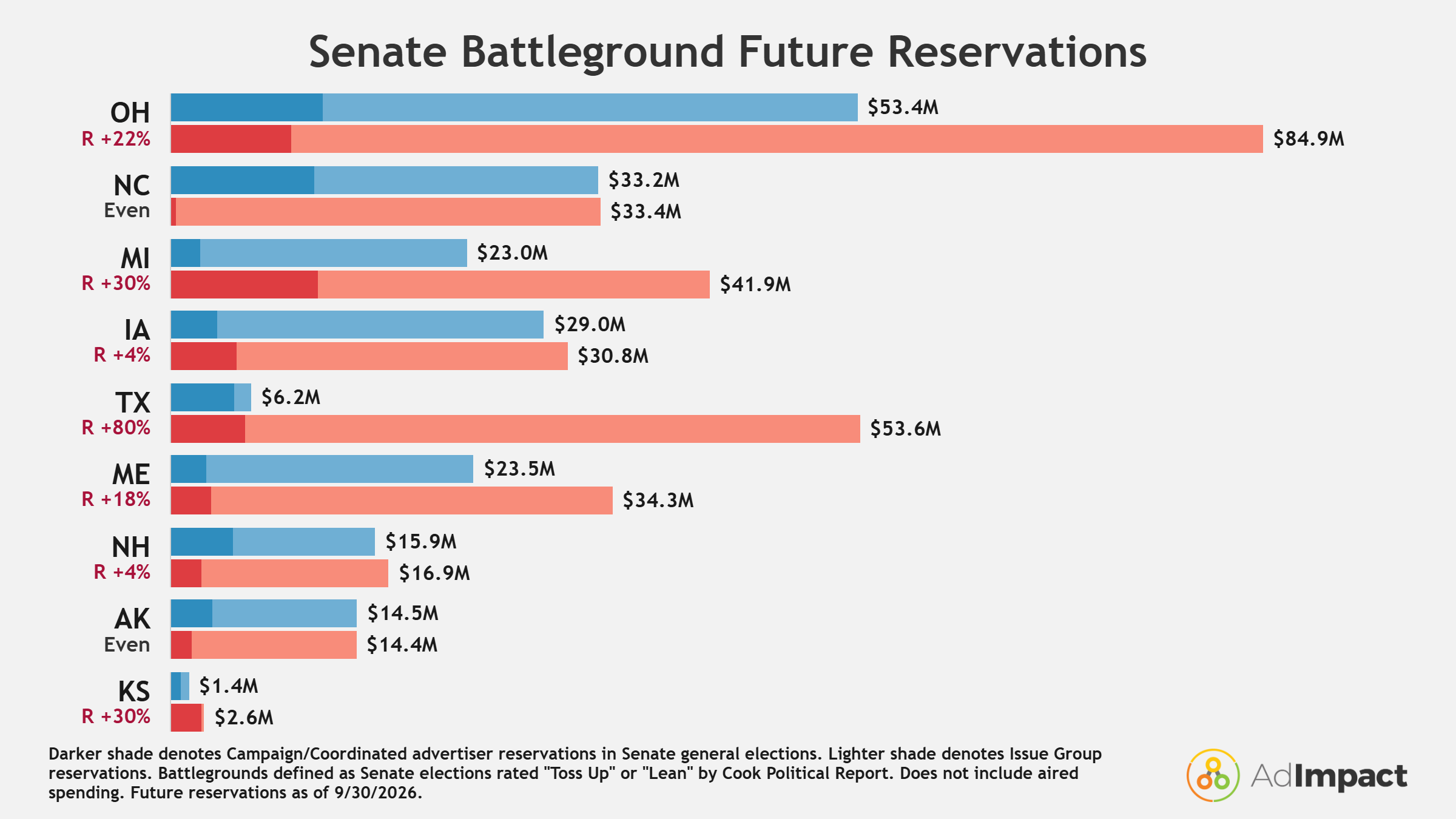
Issue groups accounted for 52% of Democratic aired spending through 9/30 but makes up 77% of their current reservations. Democrats leveled the playing field with higher candidate and coordinated activity through the end of September but only have $45.1M in such reservations. The advertising landscape will certainly change by Election Day, but through the end of September, Republicans have broken a three-cycle trend in Senate battleground spending.