


Movie theaters have struggled to replicate the success of the pre-Covid summer blockbuster season. While Barbenheimer made waves three years ago, it didn’t lead to sustainable success. This year, however, seems to have made the splash theaters have been searching for.
Spider Man: Brand New Day smashed North American box office records, bringing in $360 million on its opening weekend, while The Odyssey became the highest-grossing IMAX release of all time. Other big winners include Toy Story 5 and The Devil Wears Prada 2.
As we near the end of the season, we’re taking stock of how studios promoted their biggest releases and what those strategies could tell us about the holiday season and next year’s slate.
Summer Blockbusters Lean on CTV
Across movie advertisements aired between May 1 and August 12, 2026, one trend stands out: broadcast advertising declined sharply, while CTV impressions climbed.
In summer 2025, there were 192K broadcast airings and 15.2B CTV impressions. This summer, broadcast airings fell to 93.6K, a decline of more than 50%, while CTV impressions increased to 17.7B impressions, up roughly 16%.
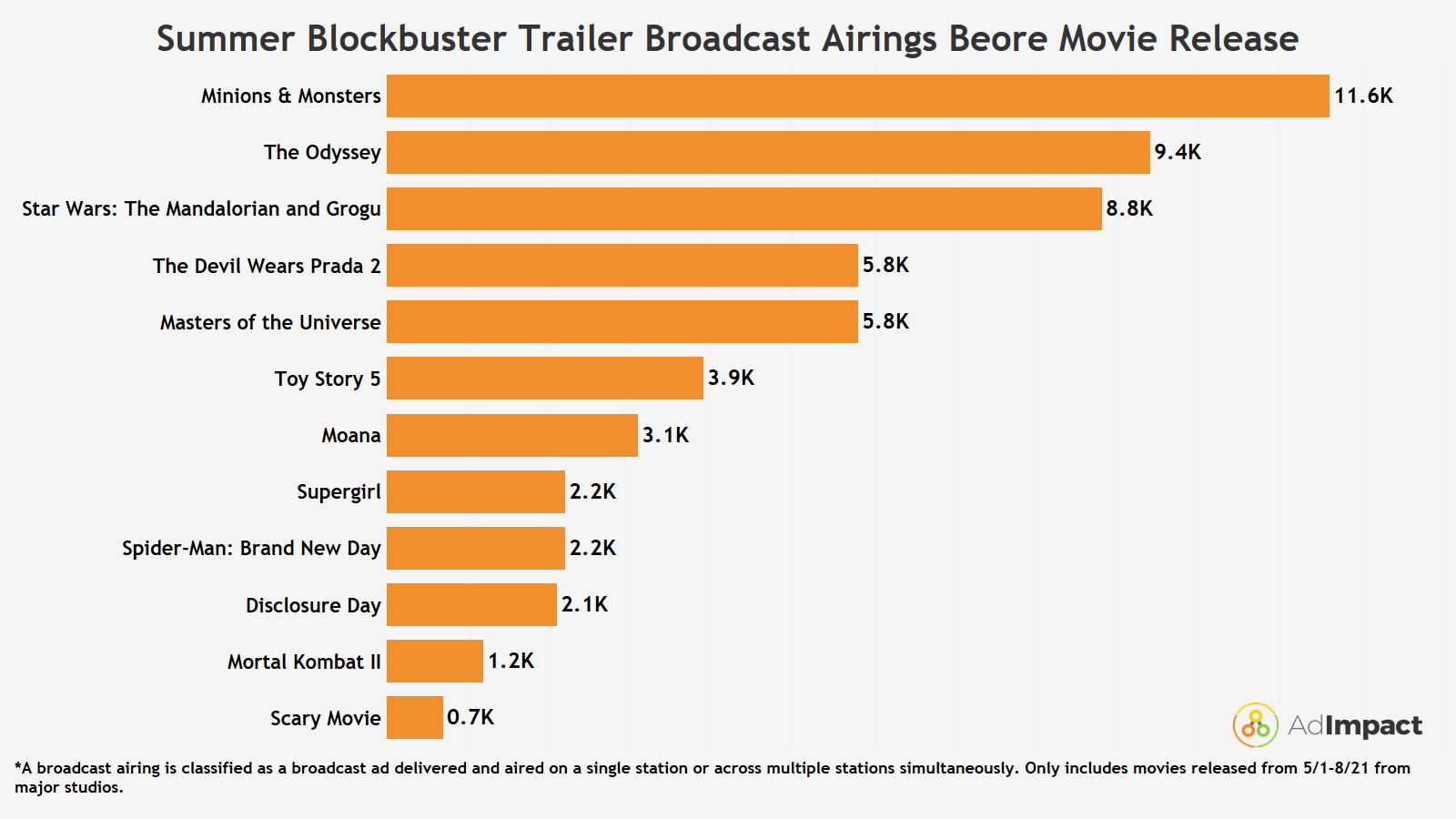
The Odyssey especially leaned into CTV, generating more than 1.8M impressions before its release and another 741M afterward, the most of any movie released this Summer. In total, Odyssey's CTV ad impressions make up 15% of total movie CTV ad impressions from 5/1 to 8/18. On broadcast, the movie logged 9.4K pre-release airings and 2.3K post-release airings.
Even movies aimed at audiences with a strong nostalgia component embraced streaming. The Devil Wears Prada 2, for example, generated more than 92M CTV impressions before its release.
The shift suggests that studios increasingly see CTV as a way to reach moviegoers at scale. Broadcast remains part of the mix, but streaming is continuing to make up a larger share of movies’ advertising strategy. With major releases like Avengers: Doomsday and Dune 3 still ahead, that gap could continue to widen.
Maximizing Summer of Sports
Streaming wasn’t the only major theme of the summer. Studios also used some of the year’s biggest sporting events to put upcoming releases in front of massive audiences.
The World Cup, which ran from June 11 to July 19, gave movie marketers a particularly valuable stage. With 47.9M watching the US game against Belgium and 49.9M watching the final, studios had repeated opportunities to reach highly engaged audiences throughout the tournament.
No movie took greater advantage than Minions & Monsters, which premiered July 1. During World Cup games, 1.4K airings promoting the movie aired. The Odyssey was a distant second with 600 ad airings, followed by Supergirl with 175.
The NBA Finals provided another prime opportunity. As we previously found, movie ads accounted for 11% of all advertising aired during the five-game series between the New York Knicks and San Antonio Spurs. Major summer releases promoted during the series included Minions & Monsters, Toy Story 5, Super Girl, Masters of the Universe, Disclosure Day and The Odyssey.
Minions & Monsters started even earlier, using the Super Bowl in February to begin building awareness months before its July premiere. It was one of only three summer blockbusters to debut a trailer during the game, alongside Star Wars: The Mandalorian and Grogu and Disclosure Day.
This strategy highlights how live sports and other tentpole events offer not only enormous audiences, but audiences watching in real time and paying attention. For studios willing to start campaigns months in advance, those events can serve as early anchors for a much longer promotional push.
The Advertising Window
Across the movies analyzed, the average window between the first broadcast ad airing and theatrical premiere was 95 days. However, that average masks dramatically different strategies.
Moana had the shortest runway, with advertising beginning just seven days before its premiere. The movie generated 3.1K broadcast airings and 102.6M CTV impressions during that period. Disney then significantly ramped up its campaign after the premiere, generating 46M CTV impressions following its release.
Mortal Kombat II had the next shortest window at 25, while Scary Movie and Toy Story 5 each began advertising 26 days before their premieres. These campaigns also maintained or increased their advertising after opening weekend. Mortal Kombat II generated 251M CTV impressions before release and 615M afterward, while Toy Story 5 increased from 156M impressions pre-release to 175M post-release.
At the other end of the spectrum, The Odyssey began advertising 175 days before its premiere, followed by Supergirl at 152 days and 143 days for Minions & Monsters. All three movies invested heavily in building awareness before opening weekend, with their pre-release activity outpacing their post-release campaigns. For example, Supergirl generated 360M CTV impressions before its premiere compared to 243M afterward.
Taken together, the data shows there is no single playbook for marketing a summer blockbuster. Some studios are using months-long campaigns and major sporting events to build anticipation well before opening weekend. Others are concentrating their spending closer to release and continuing to advertise aggressively once a movie is already in theaters.
What is increasingly consistent is where that advertising is happening. CTV has become a central part of the movie marketing mix, even as studios continue to use broadcast, particularly around high-value live events, to generate mass awareness.
As Hollywood moves into the holiday movie season and begins promoting next summer’s big releases, expect that combination to become even more pronounced.
Methodology:
-A CTV impression is a single ad delivery to a TV observed on a CTV app or device that's not viewing linear programming.
-A broadcast airing is classified as a broadcast ad delivered and aired on a single station or across multiple stations simultaneously.