-1.png)



The most prominent issue in political advertising thus far in the 2025-2026 cycle isn’t about any one policy — it’s President Donald Trump.
A review of over 6K broadcast creatives totaling more than 5M airings from this cycle found that ads referencing Trump are outpacing ads about issues such as taxes, healthcare, immigration and crime. Trump appeared in 500K more broadcast ad airings than taxation, the next most frequently featured issue.
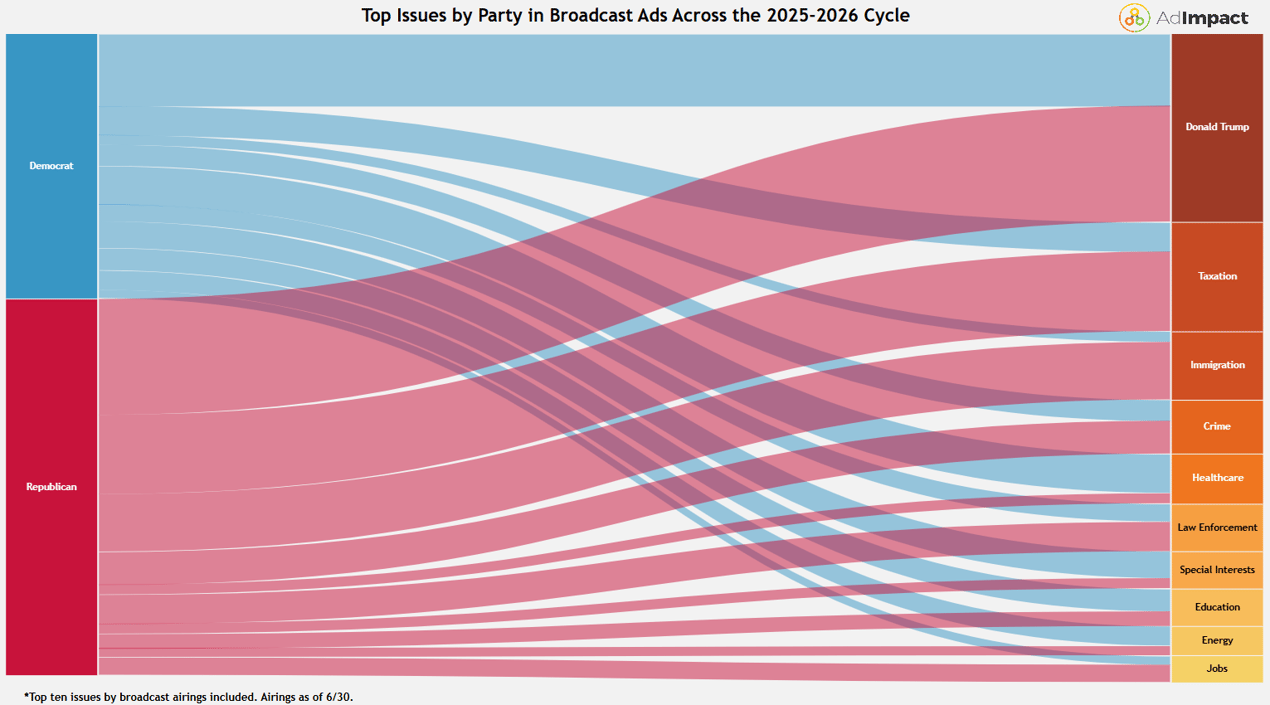
President Trump has been featured in more than 1.1M broadcast airings so far this cycle, accounting for 36% of all broadcast airings. For comparison, excluding presidential election advertising, Trump appeared in 16% of broadcast airings at this point in the 2019–2020 cycle, 13% in 2021-2022, and 12% in 2023-24.
In June alone, President Trump appeared in 40% of all broadcast airings, making him the most frequently featured issue of the month — continuing a trend that has held every month so far in 2026.
The advertisers that have featured Trump the most by broadcast airings have been Rick Jackson for GA Governor (32.5K), Burt Jones for GA Governor (27.2K), Tom Steyer for CA Governor (24.7K), Raja Krishnamoorthi for IL Senate (24.3K), and Mayes Middleton for TX Attorney General (19.5K).
Running With Trump, Running Against Trump
Both parties have frequently used Trump in their messaging. Republican advertisers have featured the President in 44% of their broadcast airings, compared to 37% of airings from Democratic advertisers. A closer look at the ads reveals how campaigns across the political spectrum are using Trump as a messaging tool.
In Republican candidate advertising, Trump is often used as a signal of alignment and conservative credibility. Candidates frequently highlight Trump’s endorsement or their support for his agenda as reasons voters should support them. An ad from Barry Moore for AL Senate emphasizes Trump’s endorsement as a key reason to support Moore’s candidacy.
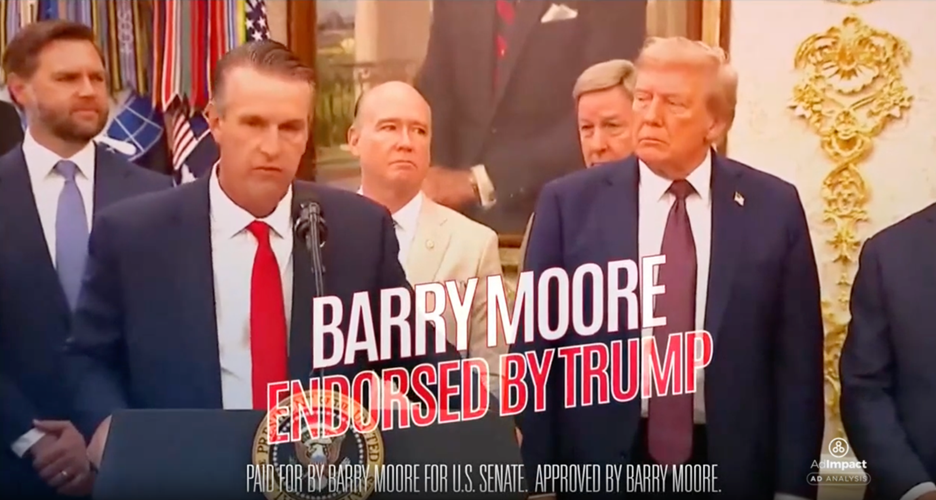
"And he's endorsed by President Trump."
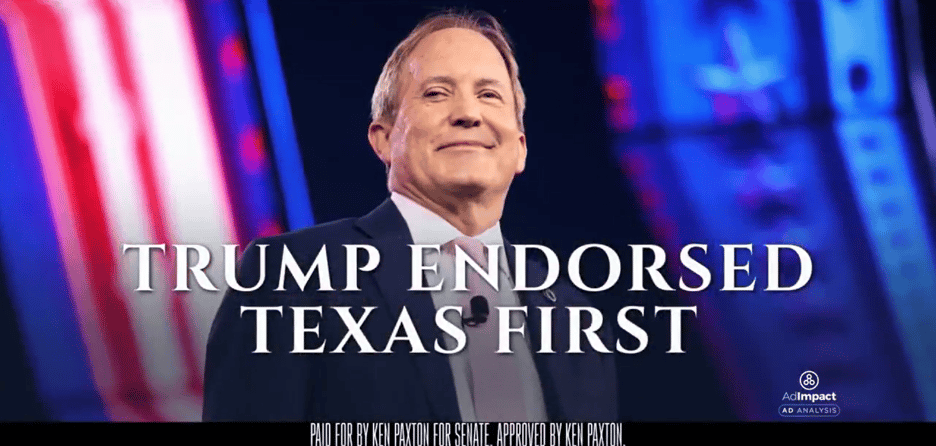
The Texas Senate primary runoff saw two candidates, John Cornyn and Ken Paxton vying for Trump's endorsement. Two days after Ken Paxton landed Trump's coveted endorsement, he released an ad touting the President's choice. While prior Paxton and John Cornyn's ads highlighted their support of the President's agenda, the Paxton campaign was ready to release ad creatives featuring Trump's endorsement.
Republican issue groups often employ a similar strategy. In this ad from Accountability Project, Trump’s endorsement is presented as evidence that Julia Letlow is the conservative voters can trust.
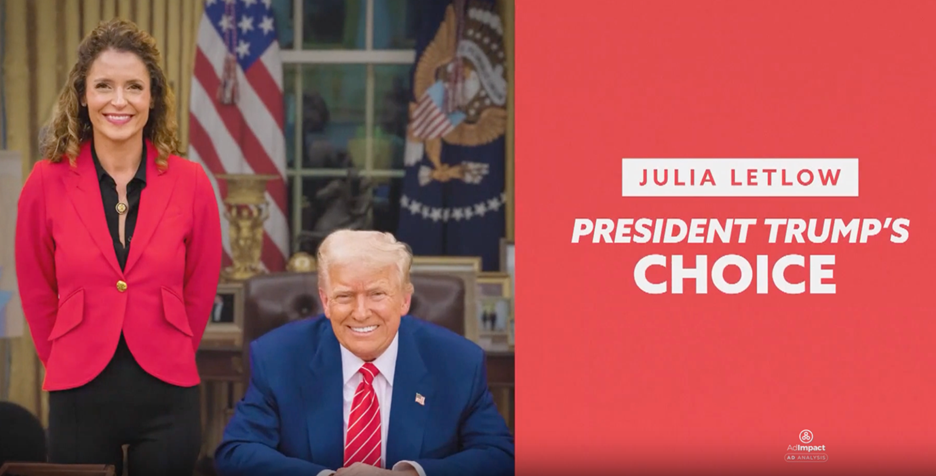
"President Trump gave Julia Letlow his complete and total endorsement.
He knows Julia Letlow is a Trump conservative who will always stand strong."
Trump is also an important messaging tool for Democratic advertisers in their primaries. Rather than emphasizing alignment, Democratic ads present opposition to Trump as a key platform issue for candidates to stand on.
In a field crowded with Democratic candidates, Steyer featured his long standing opposition for Trump as one of his central themes in his ad messaging. Steyer released 10 different broadcast creatives attacking the President. In one ad, Steyer highlights that he's "been opposing Trump and fighting him since 2017."

"I have been opposing Trump and fighting him since 2017."
Similarly, Democratic issue groups frequently use Trump as a contrast message, tying him to policy concerns and positioning their preferred candidates as a counterbalance to his influence. In an ongoing tight three-way Democratic primary for Michigan Senate, an ad from issue group, A Stronger Michigan links Trump to high gas prices while presenting Haley Stevens as the candidate willing to fight back.
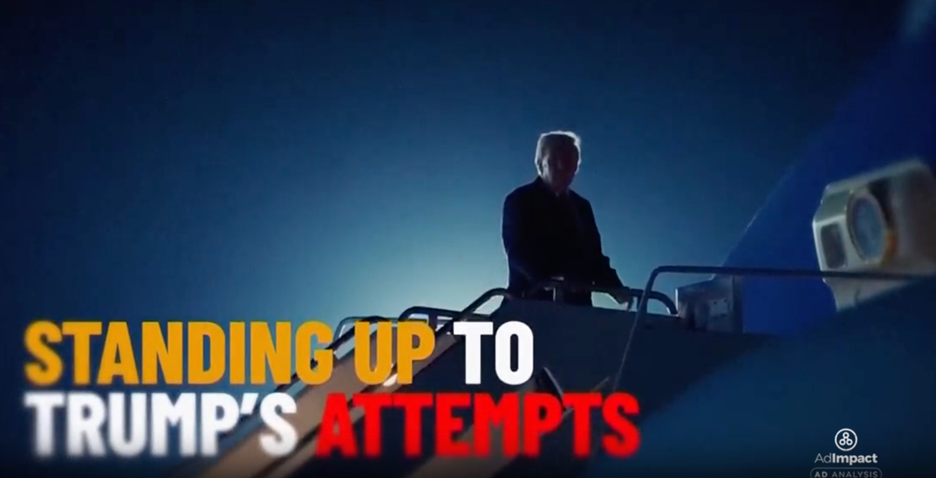
"It's Donald Trump's fault. That's why Haley Stevens is fighting back."
Beyond primaries, Democratic advertisers have also tied their Republican general election opponents to Trump. An ad from Graham Platner attacks Susan Collins based on her pro-Trump voting record.

"She's voted with Donald Trump 95% of the time."
As we head into the general election, one question will be whether campaigns continue to center their messaging on Trump or begin shifting back toward traditional policy issues. AdImpact will continue to monitor ad trends, so stay tuned throughout the cycle for further analysis.