

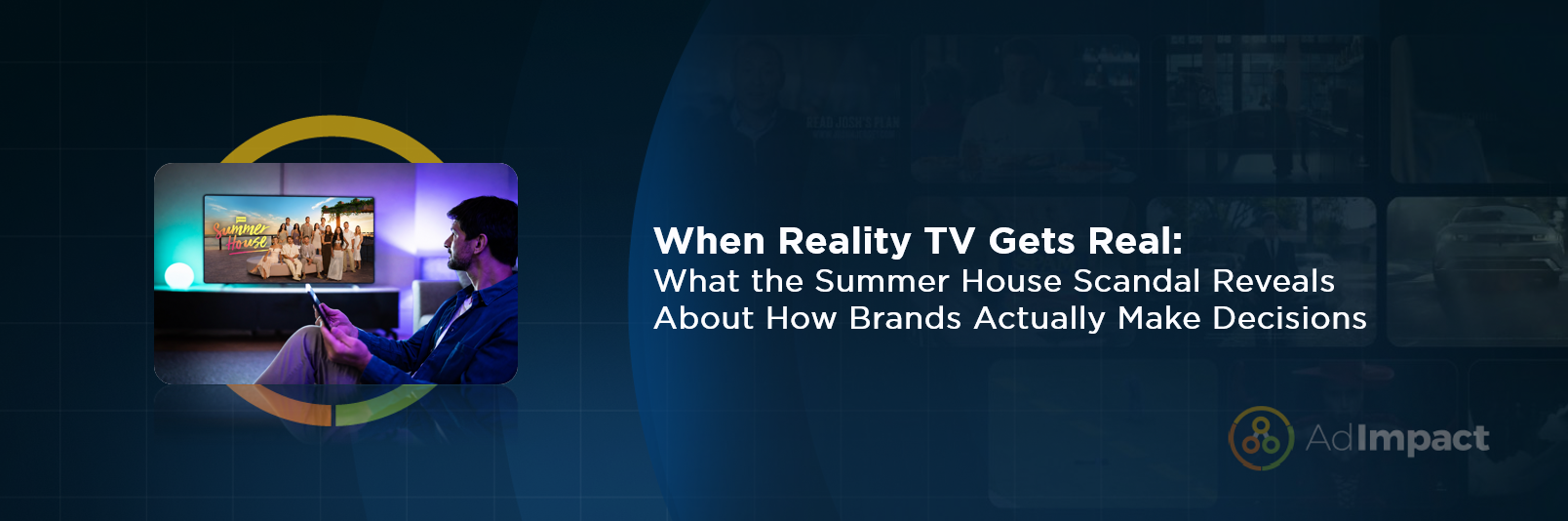
A scandal that broke Bravo's most beloved friend group this season also reshaped an entire advertising marketplace. We're not talking Scandoval — we're talking about West Wilson, who spent a whole season pretending he still had feelings for Ciara Miller, then turned around and got with her newly divorced best friend Amanda Batula. Absolute villain behavior. But while the internet was busy picking sides, AdImpact was watching something else entirely: how a pop culture earthquake shifts the behavior of the people who make content possible — the advertisers.
What we found was more sophisticated than anyone expected.
Spend the week of the scandal actually ticked up from the pre-scandal average. The pullback came 2-3 weeks later, as slower-moving brand safety decisions worked through the pipeline. Then the audience caught up, and so did the money. By the reunion, weekly spend hit $5.08M, the highest in months, where even more advertisers chose Bravo. What the numbers reveal is more sophisticated than a simple viewership bump: brands monitored, timed, and made platform-specific bets that were invisible without this week-by-week data. Viewers and advertisers alike love a Bravo scandal.
A Calculated Risk
A handful of retail brands took an even more calculated approach — treating the reunion like a tentpole event. Macy's spent almost nothing on Bravo during the regular season. At the reunion, spend surged 1,042%. Lowe's followed the same pattern, as they were quiet all season, then up +946% at the reunion. Marshalls, also largely absent during the show, exploded at +752%.
This isn't a coincidence. These brands appear to have made deliberate decisions to conserve budget during the regular season and activate heavily at the moment of peak cultural intensity. It is the same logic that drives Super Bowl advertising when the audience is largest and most engaged.
The reunion was clearly treated like event TV by a significant group of advertisers. There were even watch parties in every state around the country. Macy's, Lowe's, and Marshalls didn't stumble into those numbers. They planned around them.
Overall, our data found most advertisers followed a few behavioral patterns.
The opportunists moved in as the scandal escalated and peaked at the reunion: Burger King (+162%), Chipotle (+382%), Olive Garden (+219%), Allstate (+151%), and US Bank (+488%). These brands appear to have assessed the viewership trajectory and decided the engaged audience was worth more than the content risk. After all, Ciara Miller , did not only win the “Allison Williams Cool Girl Award" at the Las Culturistas Culture Awards, she also won the season, booked Love Island and made bank with brand deals.
The strategists held back during the controversial middle of the season and returned for the reunion, suggesting a "wait and see" posture that resolved in favor of re-engagement once the reunion stage was set. Purina, Subaru, Goldfish, and Aleve all fit this pattern.
The exits were swift and systematic. Subway declined 81% post-scandal and never returned. Outback Steakhouse fell 74%. Delta Airlines exited immediately and completely. In each case, spend and impressions declined in lockstep, confirming these were genuine pullbacks, not CPM optimizations or inventory shifts.
Cable Won, Streaming Didn’t
Cable viewers, and Bravo fans specifically, are appointment-watchers. When a show breaks the internet the way Amanda broke Ciara’s years long friendship, the audience that shows up for the reunion isn't casually scrolling, like West casually conceals his real behavior. They're engaged in a way that advertisers recognize and respond to, like Kyle is engaged in Amanda’s overall wellbeing.
The contrast with Peacock, the streaming home for Bravo content, is striking. While Bravo's impression index climbed to 118 at the reunion (18% above its January baseline), Peacock's index ended the reunion period at 96, below where it started. Bravo's share of the combined Bravo/Peacock impression pool grew from 0.19x during the regular season to 0.37x by the final reunion episodes.
An additional split between Bravo and Peacock came down to the advertiser level. Hyundai increased Bravo spend 73% at the reunion while cutting Peacock spend 71%. Wells Fargo went up 171% on Bravo and down 72% on Peacock simultaneously — while its overall media spend was actually declining. Xfinity's moves were almost precisely mirrored: up 57% on Bravo, down 57% on Peacock post-scandal. Febreze nearly exited Peacock entirely (down 99%) while maintaining its Bravo presence throughout. Most brands actively chose cable over streaming because they knew the viewers engagement was priceless.
What This Means Beyond Summer House
The Summer House analysis is a proof of concept for a broader argument: that the advertising marketplace around premium cable content is more sophisticated, more reactive, and more strategically nuanced than most industry conversations acknowledge. Sports is not the only way to reach live viewers.
Brands are adjusting and are not only relying on content adjacency filters. Brands are monitoring timing. They are making platform-specific decisions within media companies, that would be invisible to anyone without week-by-week, network-level spend and impression data. They are treating reunion episodes like sporting events, as they should be.
The brands that won this season weren't the ones with the most conservative brand safety policies. They were the ones that understood what the audience was doing — and planned around it. These advertisers captured one of the most engaged Bravo audiences in months. The ones who didn't, missed it entirely.
There's an irony in that. West allegedly thought Amanda would be the hero of this story and latched on accordingly. Wrong choice, West. You can't game a fanbase that's been watching for years — they will see through it every time. West has since been cut from the show ahead of next season's filming