

The quick-service restaurant industry may look stable at first glance, but beneath the surface, major shifts are reshaping how brands advertise across television. While overall Q1 broadcast advertising levels for QSR chains have remained relatively flat in recent years, streaming continues to emerge as a key growth driver. From regional chicken chains punching above their weight on broadcast, to coffee giants battling for dominance, to burger brands dramatically shifting their TV strategies, AdImpact’s Q1 2026 data reveals an industry increasingly balancing traditional television with the rapid rise of CTV.
AdImpact tracked 1.9M broadcast airings in Q1 2026, nearly identical to Q1 2025 and Q1 2024. Meanwhile, CTV impressions rose 11% while comparing Q1 2025 to Q1 2026, signaling that growth in QSR advertising is increasingly driven by streaming.
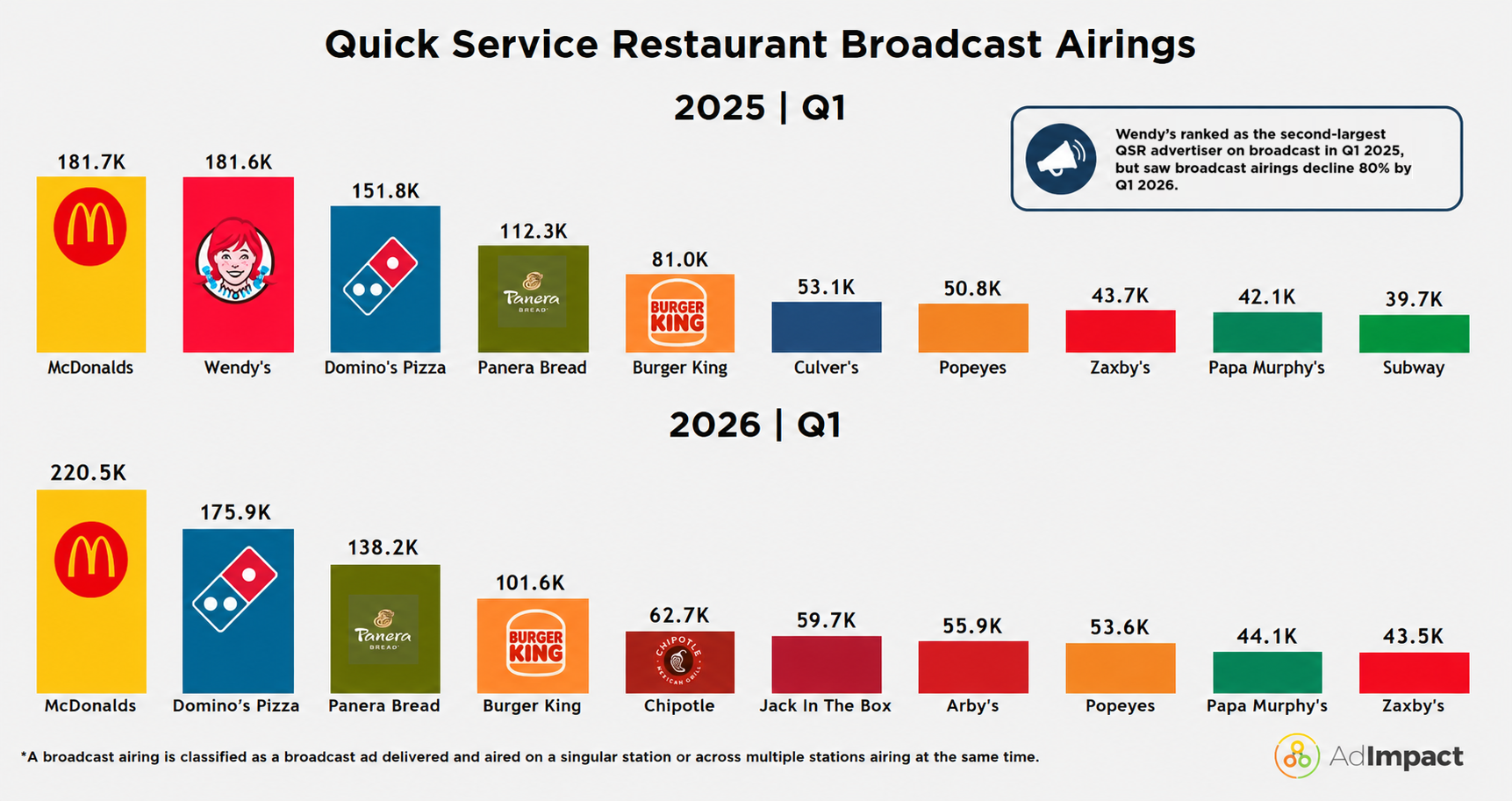
On broadcast, the leading advertisers are largely familiar national brands. McDonald’s, Domino’s, Panera, and Burger King rank among the top advertisers by airings in Q1 2026. More notable, however, is the continued presence of regional players like Culver’s and Zaxby’s, which continue to compete at scale on linear TV.
CTV tells a different story, one dominated almost entirely by national chains. In Q1 2026, McDonald’s (3.1B impressions), Chick-fil-A (2.7B), Arby’s (2.4B), Little Caesars (1.3B), and Domino’s (1.1B) lead the category. While regional chains were among the top ten advertisers on broadcast by airings, no regional chain cracks the top 15 on CTV while looking at impression data. The highest-ranking local advertisers Zaxby’s (607M), Whataburger (333M), Wawa (320M), Carl’s Jr. (308M), and Jack in the Box (291M) trail significantly behind the top national chains.
These dynamics point to evolving strategies among major QSR advertisers. Wendy’s, for example, nearly challenged McDonald’s as the top broadcast advertiser in Q1 2025, but saw an 80% drop in broadcast airings in Q1 2026 compared to Q1 2025. On CTV, however, Wendy’s impressions declined just 5% year-over-year, suggesting that while the chain is pulling back on advertising overall, it’s pulling back on CTV the least.
From a messaging perspective, core themes remain consistent with past years. Value meals and loyalty programs continue to dominate QSR advertising, making up a significant share of broadcast airings for brands like McDonald’s, Subway, and Wawa.
At the same time, “hot honey” has emerged as a notable trend, with McDonald’s, Bojangles, KFC, Papa Murphy’s, and others heavily promoting menu items featuring the flavor in Q1.
Chicken Chains Continue to Grow
Chicken chains have been one of the biggest growth drivers in the QSR industry over the past several years. In 2025, chicken-focused brands grew 5.3%, outpacing the rest of the industry, which grew 3%. That momentum is also showing up in advertising activity.
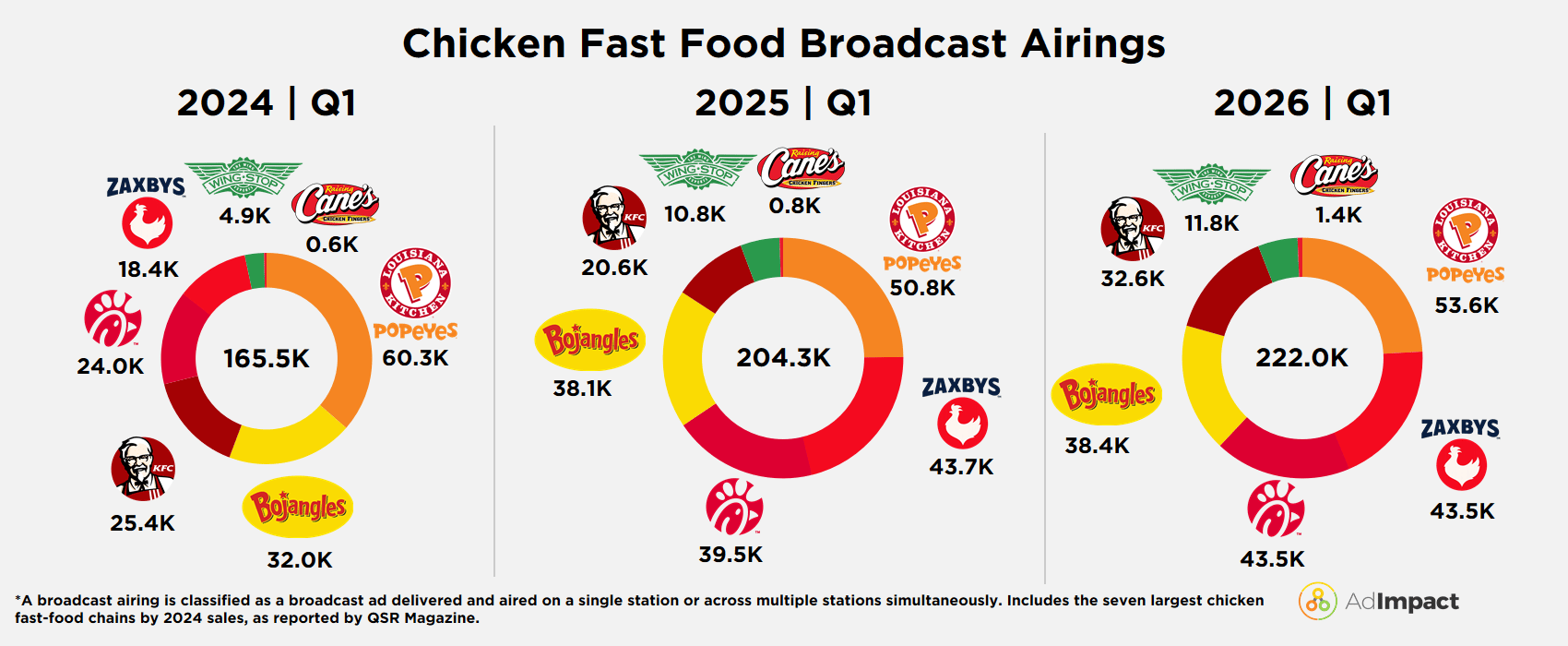
Broadcast airings among the top chicken chains increased 34.1% from Q1 2024 to Q1 2026. Growth on CTV has been even more dramatic. Chicken chains generated more than 1.1B CTV impressions in Q1 2024, a figure that surged to 4.1B impressions by Q1 2026, a 310% increase.
Popeyes has consistently led the chicken QSR category in broadcast advertising airings during the first quarter since 2024. At the same time, regional chicken chains have continued to punch above their weight on broadcast television. By 2025, both Bojangles and Zaxby’s accounted for a sizable share of chicken chain broadcast airings, with each brand airing more ads than national chain KFC. Continuing that point, alongside Raising Cane’s, Zaxby’s has more than doubled its broadcast airings since Q1 2024.
Dunkin’ vs Starbucks
It’s an East Coast vs. West Coast battle, in essence a rematch of the last Super Bowl between the New England Patriots and the Seattle Seahawks: Boston-based Dunkin’ vs. Seattle-based Starbucks. What began as a tight broadcast advertising race between the two coffee giants turned into a blowout after 2024. In Q1 2024, Starbucks held just a 5K broadcast airing advantage over Dunkin’. By Q1 2025, that lead had jumped to 77K airings. While Starbucks enjoys a large advantage in broadcast airings, the gap is much narrower on CTV. In Q1 2026, Starbucks had 671M impressions compared to Dunkin’s 612M.
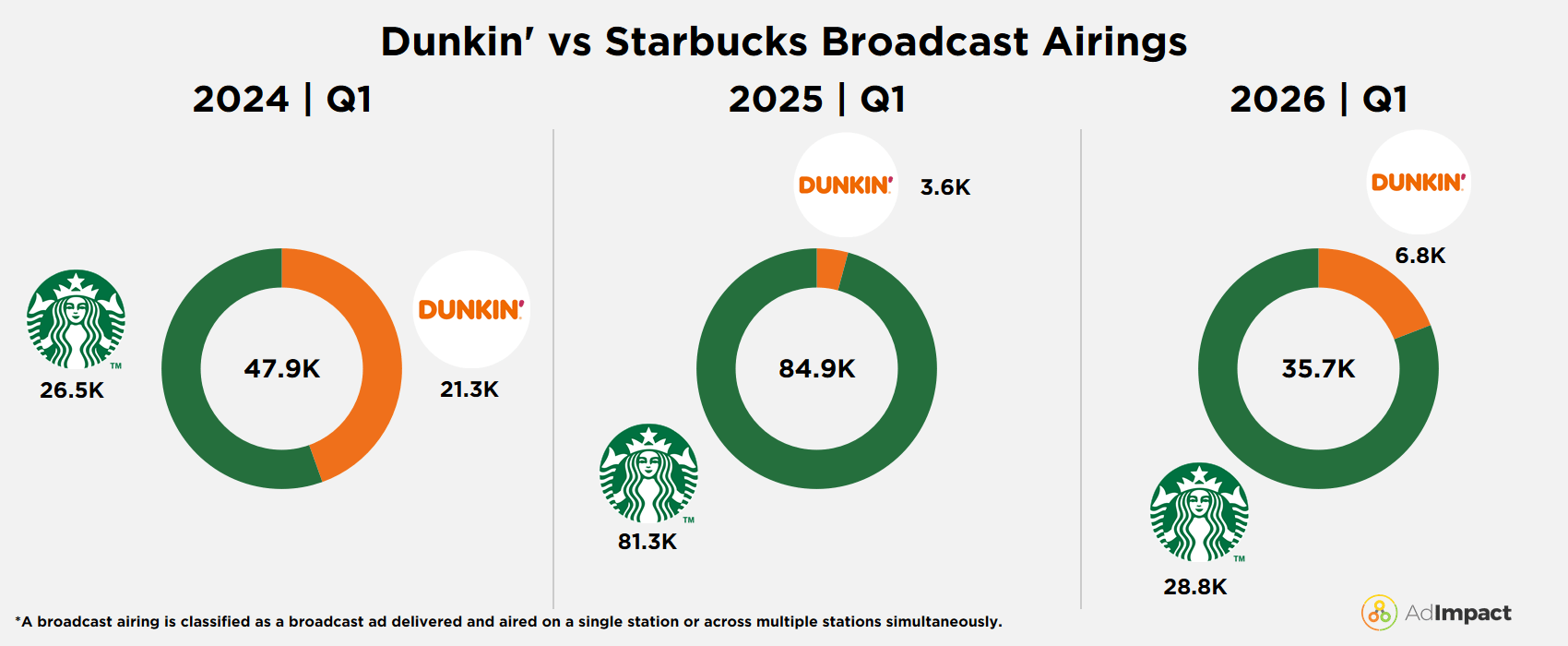
Q1 2025 marked a major surge in Starbucks advertising activity, with the chain nearly tripling its broadcast airings compared to Q1 2024. Starbucks also expanded its CTV presence significantly, generating 240M more CTV impressions year-over-year, signaling a broader push across both linear and streaming TV.
By Q1 2026, Starbucks’ advertising levels cooled and returned closer to 2024 norms. The chain recorded 28.8K broadcast airings in Q1 2026, a sharp decline from its elevated 2025 pace.
Domino’s Dominates Pizza Advertising
Apparently, when it comes to advertising, other chains really can out-pizza the Hut. Domino's has led the pizza QSR category in Q1 broadcast advertising for the past three years. Behind Domino’s, however, the battle for second place has shifted dramatically.
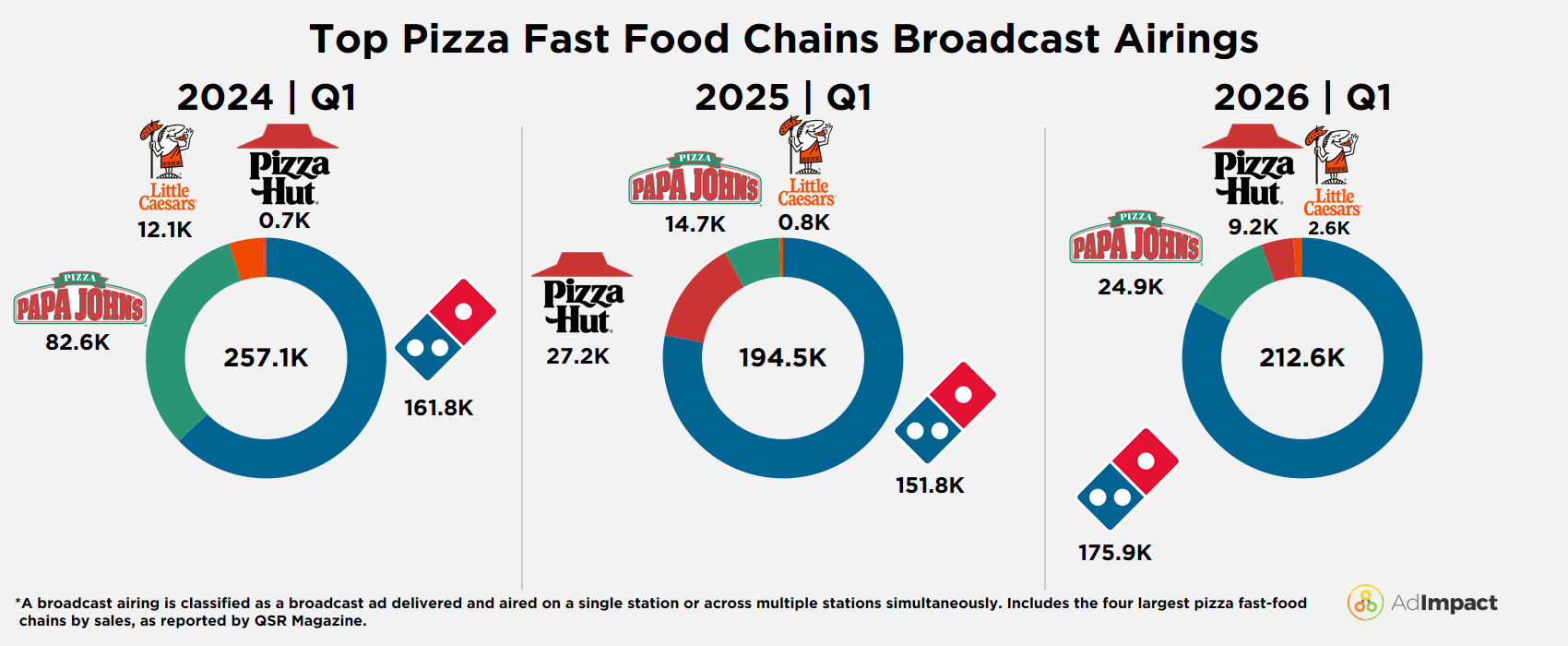
After Papa John's significantly pulled back its broadcast advertising in Q1 2025, Pizza Hut surged into the No. 2 spot. Pizza Hut jumped from roughly 700 broadcast airings in Q1 2024 to 27.2K airings in Q1 2025.
Another notable trend across the pizza category was the broader decline in broadcast advertising during Q1 2025. Combined broadcast airings among the major pizza chains fell 26% year-over-year from Q1 2024 levels. While airings rebounded to 212.6K in Q1 2026, the category still remained below its Q1 2024 total.
On CTV, the story is a bit different. While Domino’s leads in broadcast airings, Little Caesars leads in CTV impressions.
The Burger Wars
No segment of the QSR category may be changing more rapidly than fast food burgers. As mentioned earlier, Wendy’s was a major force in broadcast advertising in both Q1 2024 and Q1 2025. The chain ranked as the top fast-food advertiser in Q1 2024 and the second-largest in Q1 2025, before seeing a sharp decline in broadcast airings in Q1 2026.
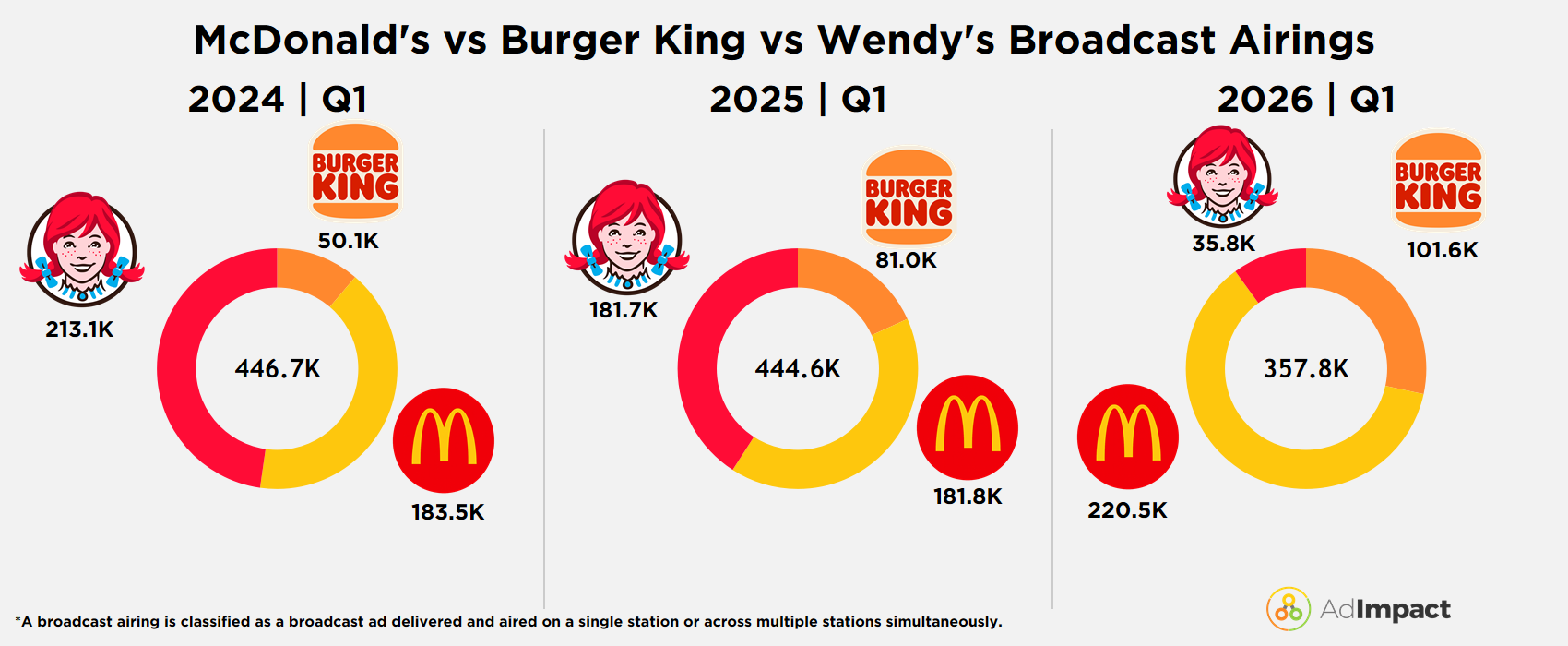
A similar dynamic appears in CTV advertising, where McDonald’s continues to dominate the category. The chain delivered 3.1B CTV impressions in Q1 2026, far ahead of Burger King’s 971M and Wendy’s 731M.
While Wendy’s broadcast advertising declined, Burger King’s steadily increased across Q1 data from 2024 through 2026. In Q1 2026, Burger King aired its highest volume of broadcast ads in recent years, potentially fueled by its new “You Rule” campaign which made an appearance during advertising for this past year’s Super Bowl. However, the chain appeared to pull back on CTV advertising this year. Burger King’s CTV ads generated more than 1.6B impressions in Q1 2025, compared to 971M in Q1 2026.
Regional Chain Local Advertising Deep Dive
Zaxby’s Southwestern Advertising
Zaxby’s broadcast and CTV advertising closely mirrors the chain’s geographic footprint, which remains concentrated in the Southeast. The northernmost market where Zaxby’s advertised in Q1 2026 was Indianapolis, where the chain operates five locations. While Zaxby’s has recently expanded into more northern states such as Maryland and New York, the company has yet to air broadcast advertising in those markets.
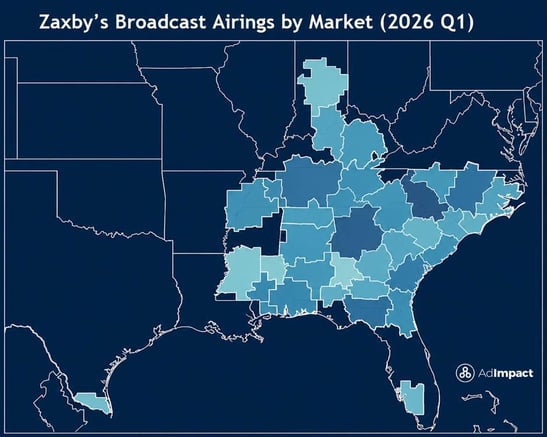
Atlanta saw the highest volume of Zaxby’s broadcast airings in Q1 2026, which aligns with the chain’s strong presence in Georgia. The city of Atlanta itself has eight Zaxby’s locations, the second-most of any city in the country.
CTV and Broadcast Ads Follow Wawa's Expansion Path
With the chain’s first Tennessee location set to open, Wawa now has a presence across 14 states, more than doubling the six states it operated in at the start of the decade. As new locations open, advertising follows. In Q1 2024, Wawa aired broadcast ads in just eight markets. By Q1 2026, the chain was active on broadcast across 27 markets. Many of the new markets where Wawa advertised align with the chain’s recent expansion efforts in western Pennsylvania, the Midwest, and the Mid-Atlantic.
.png?width=1076&height=696&name=wawa-heatmap-5.27.26_v1a%20(1).png)
On CTV, we’re seeing the same strategy of advertising following expansion from Wawa. While their top markets by CTV ad impressions were in their preestablished markets: Philadelphia (49M), Tampa (19M), Orlando (19M) and Washington D.C (18M), Wawa has expanded CTV advertising to new markets as well. In the Midwest, Indianapolis (14M) and Louisville (13M) became top-10 markets for Wawa's CTV advertising in Q1 2026, with Cincinnati (8M), Dayton (8M), and Lexington (9.1M) also seeing huge jumps in CTV impressions between 2024 and 2026. In the Mid-Atlantic, Roanoke saw a huge jump from 580K impressions in Q1 2024 to 11.8M in Q1 2026, with similar jumps happening in Raleigh (5M), Harrisburg (8M), and Wilkes Barre (7.5M).
Taken together, Q1 2026 data points to an industry in transition. Broadcast remains the domain of regional brands willing to compete aggressively on linear TV, but CTV is increasingly where national chains are pressing their advantages. Regional chains like Wawa looking towards expansion are utilizing both broadcast and CTV to advertise following their own expansion footprints